
Is medical insurance pre tax? Yes—and understanding how pre-tax medical insurance works is one of the smartest moves you can make for your wallet. When you pay for health insurance through your employer using pre-tax dollars, you’re essentially telling the IRS, “Don’t tax this money before I use it for healthcare.” This simple strategy can save you thousands of dollars annually by reducing your taxable income and lowering your overall tax burden.
Table of Contents
How Pre-Tax Medical Insurance Works
Pre-tax medical insurance means your employer deducts your health insurance premiums from your paycheck before calculating federal income tax, Social Security tax, and Medicare tax. Think of it as a two-step process: your gross income gets reduced by your insurance premium, and then taxes are calculated on what’s left.
Here’s the practical breakdown: If you earn $50,000 annually and your health insurance costs $300 per month ($3,600 yearly), your taxable income drops to $46,400. The IRS never sees that $3,600—it’s sheltered from taxation. This is fundamentally different from paying for insurance with after-tax dollars, where you’d need to earn roughly $4,500 to afford $3,600 in premiums after taxes.
Most employees access pre-tax medical insurance through their employer’s Section 125 cafeteria plan (also called a flexible benefits plan). Your employer must offer this option, and you typically enroll during open enrollment periods. The setup is automatic—your HR department handles everything, deducting premiums directly from your paycheck.
Your Real Tax Savings Calculation
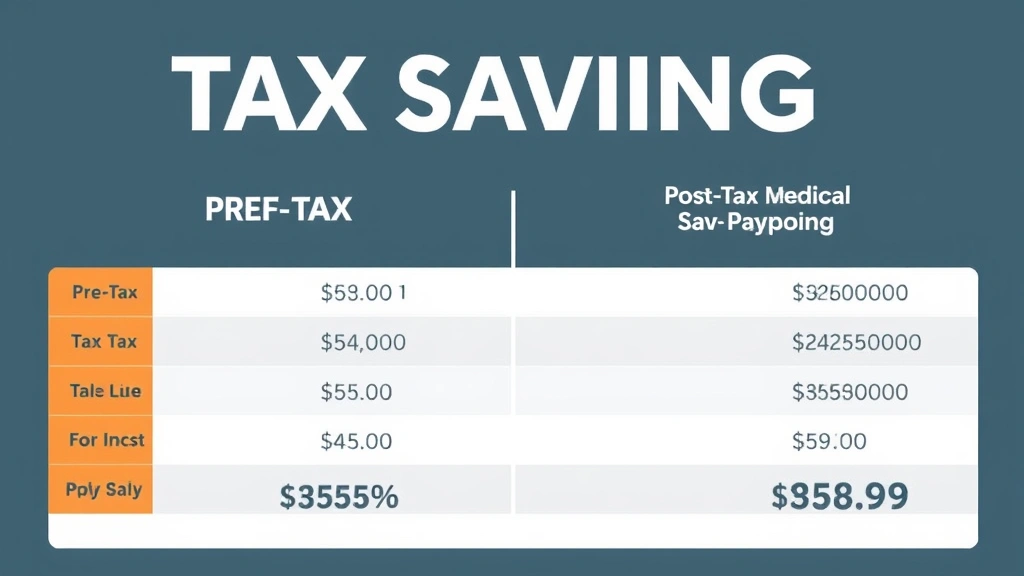
Let’s put actual numbers to this benefit. Suppose you’re a single filer in a 24% federal tax bracket, and you pay $6,000 annually in health insurance premiums through your employer’s pre-tax plan.
Tax savings breakdown:
- Federal income tax savings: $6,000 × 0.24 = $1,440
- Social Security tax savings: $6,000 × 0.062 = $372
- Medicare tax savings: $6,000 × 0.0145 = $87
- Total annual savings: $1,899
That’s nearly $2,000 in your pocket just by using pre-tax dollars. For a family paying $15,000 in premiums, the savings could exceed $4,500 annually. These aren’t theoretical benefits—this is real money that stays in your account instead of going to the IRS.
The beauty of this strategy is that it works regardless of whether you itemize deductions or take the standard deduction. Unlike medical expenses you pay out-of-pocket (which only become deductible if they exceed 7.5% of your adjusted gross income), pre-tax insurance premiums provide an immediate, guaranteed reduction in your tax liability.
Employer-Sponsored Plan Options
Your employer likely offers several pre-tax medical insurance options, each with different structures and cost-sharing arrangements. Understanding these options helps you choose the plan that genuinely fits your healthcare needs and budget.
Health Maintenance Organizations (HMOs) typically have lower premiums because they require you to use in-network providers. You’ll pick a primary care physician who coordinates your care. Out-of-pocket costs are usually predictable, but you have less flexibility.
Preferred Provider Organizations (PPOs) offer more flexibility—you can see any doctor, though in-network providers cost less. Premiums are higher, but you get the freedom to choose specialists without referrals.
High-Deductible Health Plans (HDHPs) pair with Health Savings Accounts (HSAs), which we’ll discuss separately. These plans have lower premiums but higher deductibles, making them ideal if you’re generally healthy.
Each plan option processes premiums through pre-tax deductions, so your tax savings apply regardless of which plan you select. The key is matching the plan structure to your actual healthcare usage.
HSA vs. FSA: Which Saves More
Beyond standard medical insurance, your employer might offer additional pre-tax savings vehicles. Health Savings Accounts (HSAs) and Flexible Spending Accounts (FSAs) are both powerful tax-advantaged tools, but they work differently.
Health Savings Accounts (HSAs): These require enrollment in an HDHP. You contribute pre-tax dollars (up to $4,150 individual/$8,300 family in 2024) to an HSA, and funds roll over year to year. You can withdraw money tax-free for qualified medical expenses. After age 65, you can withdraw for any reason (taxed as income, but not penalized). HSAs offer the triple tax advantage: deductible contributions, tax-free growth, and tax-free withdrawals for medical expenses.

Flexible Spending Accounts (FSAs): These work with any medical plan. You contribute pre-tax dollars (up to $3,200 in 2024) and withdraw them tax-free for qualified medical expenses. However, FSAs have a “use-it-or-lose-it” rule—unused funds typically don’t roll over (though employers can allow up to $680 carryover in 2024).
For long-term savings, HSAs are superior because they accumulate. For short-term healthcare costs you know you’ll incur, FSAs are efficient. Many employees use both: an FSA for predictable annual expenses (copays, dental) and an HSA for long-term wealth building.
FICA Taxes and Medical Insurance
Here’s something many people miss: pre-tax medical insurance premiums reduce not just federal income tax, but also FICA taxes (Social Security and Medicare). This is a massive advantage compared to some other pre-tax benefits.
When you pay for medical insurance with pre-tax dollars, your Social Security and Medicare taxes are calculated on a smaller income base. If you earn $60,000 and contribute $5,000 to pre-tax medical insurance, you pay Social Security and Medicare taxes on $55,000 instead of $60,000.
The FICA savings add up quickly: 7.62% (6.2% Social Security + 1.45% Medicare) of $5,000 = $381 in annual FICA savings. Over a 30-year career, that compounds significantly, and it also means your Social Security benefit calculation might be slightly lower, but the immediate tax savings far outweigh this modest future impact.
For self-employed individuals, the situation is different. While you can deduct health insurance premiums as an above-the-line deduction, you still pay the full 15.3% self-employment tax. This is why understanding your specific situation matters—FICA tax on your paycheck works differently depending on your employment status.
Self-Employed and Pre-Tax Insurance
If you’re self-employed or own a small business, you don’t have access to employer-sponsored pre-tax medical insurance in the traditional sense. However, you have a powerful alternative: the self-employed health insurance deduction.

You can deduct 100% of your health insurance premiums as an above-the-line deduction on your tax return (Form 1040, line 17). This reduces your adjusted gross income (AGI), which is excellent because a lower AGI can qualify you for other tax benefits and credits.
The catch: You can only deduct premiums for months when you didn’t have access to employer-sponsored coverage. If your spouse works and has employer coverage available, you generally can’t claim this deduction for your own premiums. Additionally, you can’t deduct more than your net self-employment income.
Self-employed individuals should also consider establishing a Solo 401(k) or SEP-IRA, which can include health insurance reimbursement arrangements. This strategy adds another layer of tax efficiency to your medical insurance costs.
Common Pre-Tax Insurance Mistakes
Even though pre-tax medical insurance is straightforward, people make predictable errors that cost them money.
Mistake #1: Not enrolling during open enrollment. If you miss your employer’s open enrollment window, you typically can’t enroll in pre-tax medical insurance until the next year, unless you have a qualifying life event (marriage, birth, job loss). Missing this deadline means paying taxes on money you could have sheltered.
Mistake #2: Over-contributing to FSAs. The “use-it-or-lose-it” rule is brutal. If you contribute $2,500 to an FSA and only spend $1,800 on qualified expenses, you lose $700 (or $680 if your employer allows carryover). Be conservative with FSA contributions and base them on actual historical spending.
Mistake #3: Not understanding what qualifies. Pre-tax medical insurance covers health insurance premiums, but not all healthcare costs. Copays, deductibles, and coinsurance are covered through FSAs/HSAs, but cosmetic procedures, gym memberships, and over-the-counter medications (without a prescription) don’t qualify. Understanding the rules prevents costly mistakes.
Mistake #4: Ignoring state taxes. While pre-tax medical insurance reduces federal and FICA taxes, most states also exclude these premiums from state income tax. However, a few states don’t provide this benefit. Know your state’s rules—some states have unique requirements that affect your overall savings.
Maximize Your Medical Savings
To truly optimize your pre-tax medical insurance strategy, integrate it with your broader tax picture.
Coordinate with dependent care. If you have children, your employer might offer a Dependent Care FSA. Like medical FSAs, this uses pre-tax dollars and can save significant money. You can have both a medical FSA and a dependent care FSA simultaneously.
Review annually. Healthcare costs and your life circumstances change. During open enrollment, reassess your medical plan choice, HSA contributions, and FSA elections. A plan that made sense last year might not be optimal this year.
Leverage HSA as investment. If you have an HSA and can afford to pay medical expenses out-of-pocket (using post-tax dollars), let HSA funds grow invested in mutual funds or stocks. At retirement, you can withdraw for any reason after age 65, making HSAs a powerful long-term savings vehicle. This strategy transforms an HSA from a spending account into a retirement account.
Consider pre-tax versus Roth strategy. For most people, pre-tax medical insurance is superior to Roth alternatives because it reduces current taxable income. However, if you’re in a very low tax bracket currently, this calculus might differ.
Don’t overlook FIT tax meaning and how it interacts with your pre-tax benefits. The more you understand your paycheck components, the better decisions you’ll make.

Frequently Asked Questions
Does pre-tax medical insurance reduce my Social Security benefits?
Pre-tax medical insurance premiums reduce your current Social Security tax, which theoretically could lower your future Social Security benefit by a tiny amount. However, the immediate tax savings (typically 15%+ of your premium) far exceed any future benefit reduction. The math strongly favors using pre-tax insurance now.
Can I deduct medical insurance premiums twice?
No. If you pay premiums through your employer’s pre-tax plan, you can’t also deduct them on your tax return. The IRS doesn’t allow double-dipping. Choose one method based on your situation.
What if my employer doesn’t offer pre-tax medical insurance?
This is rare for larger employers, but if yours doesn’t, you can purchase individual insurance on the healthcare marketplace. You might qualify for premium tax credits, which function similarly to pre-tax benefits by reducing your tax liability.
Are dental and vision insurance also pre-tax?
Yes, if your employer offers them through the same cafeteria plan, dental and vision insurance premiums are also deducted pre-tax. This provides additional tax savings beyond medical coverage.
Can I change my election mid-year?
Generally no, unless you have a qualifying life event (marriage, birth, death, significant change in coverage, or job loss). You’re locked into your election for the entire plan year.
What happens to my pre-tax medical insurance if I quit my job?
Your coverage typically ends on your last day of employment. You can continue coverage through COBRA (usually expensive) or purchase individual insurance. Some employers offer retiree coverage with pre-tax treatment, but this is increasingly rare.
Bottom Line: Pre-Tax Medical Insurance Saves Real Money
Is medical insurance pre tax? Absolutely—and it’s one of the most underutilized tax benefits available to working Americans. By paying for health insurance with pre-tax dollars through your employer’s cafeteria plan, you reduce your federal income tax, Social Security tax, Medicare tax, and typically state income tax.
The math is compelling: someone in the 24% federal tax bracket with $6,000 in annual premiums saves nearly $2,000 in taxes. For families with higher premiums, the savings exceed $4,000-$5,000 annually. Over a 30-year career, that’s $60,000-$150,000 in tax savings, assuming modest inflation.
The strategy is simple: enroll in your employer’s pre-tax medical insurance during open enrollment, choose an appropriate plan for your healthcare needs, and consider supplementing with an HSA if you’re on an HDHP. If you’re self-employed, deduct your premiums as an above-the-line deduction.
Don’t leave this money on the table. Pre-tax medical insurance is a gift from the tax code—use it. For more context on how this fits into your broader tax strategy, explore tax deductible benefits and tax sheltered annuity options that might complement your medical insurance planning.