
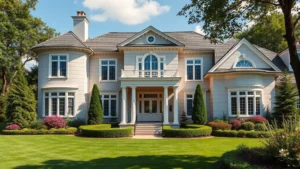
Let’s be real: buying a home in New Jersey is already expensive. Then you hear about the NJ mansion tax, and suddenly you’re wondering if you need to sell a kidney to afford that dream property. The good news? Understanding how the NJ mansion tax works can save you thousands—and help you make smarter decisions before you sign those closing papers.
If you’re shopping for a home in New Jersey, especially in desirable areas like Bergen County, Essex County, or along the Jersey Shore, the NJ mansion tax is a real cost you need to budget for. It’s not optional, it’s not avoidable (for most buyers), and it hits your wallet at closing. But here’s what most real estate agents won’t tell you: there are legitimate strategies to minimize it, and understanding the rules can change your entire financial picture.
This guide breaks down everything you need to know about the NJ mansion tax—what it is, who pays it, how much you’ll owe, and how to avoid overpaying. By the time you’re done reading, you’ll have the knowledge to walk into closing confident, informed, and ready to protect your money.
What Is the NJ Mansion Tax?
The NJ mansion tax is a state-level transfer tax imposed on the sale of residential properties in New Jersey. Think of it like a “luxury property surcharge”—the state charges you a percentage of the sale price when ownership changes hands. It’s not a property tax (which you’ll pay annually). It’s a one-time hit at closing.
Here’s the critical part: the NJ mansion tax only applies to properties that meet certain price thresholds. If you’re buying a modest home for $300,000, you won’t owe the mansion tax. But if you’re buying that gorgeous Victorian in Princeton for $1.2 million? You’re paying it.
The tax was originally designed to target ultra-wealthy buyers purchasing luxury estates. In reality, it now catches middle-to-upper-middle-class homebuyers in high-cost areas like Bergen County and Hudson County. It’s one of those taxes where the original intent and the actual impact have drifted pretty far apart.
The NJ mansion tax is separate from the state’s NJ estate tax, which applies to inheritances. And if you’re planning to eventually leave New Jersey, you’ll also want to understand the NJ exit tax, which targets high-net-worth individuals. These are three different taxes, and they all hurt.
Pro Tip: The NJ mansion tax is based on the sale price, not the assessed value. If you negotiate a lower purchase price, your mansion tax bill goes down proportionally. Every $10,000 you negotiate off the price saves you roughly $250-$400 in mansion tax.
Who Pays the NJ Mansion Tax?
Technically, the buyer and seller can negotiate who pays the NJ mansion tax—it’s not automatically assigned by law. However, in New Jersey’s real estate market, the buyer almost always ends up paying it. This is baked into typical closing costs.
Here’s why: sellers are already paying real estate agent commissions (typically 5-6% of the sale price). Adding another tax burden makes their net proceeds even smaller. So they push back and say, “You pay the mansion tax.” In a competitive market, buyers often agree just to close the deal.
Some savvy buyers try to negotiate the seller covering part of it, especially in a buyer’s market. But don’t expect this to work in hot markets like North Jersey or the Shore. Sellers have leverage, and they know it.
One more thing: if you’re buying a property as an investment (rental property, commercial real estate, etc.), the rules can be different. We’re focusing on residential owner-occupied homes here, which is where most buyers feel the pain.
NJ Mansion Tax Rates & Thresholds
New Jersey’s NJ mansion tax structure is tiered, meaning the rate increases as the sale price climbs. Here’s the breakdown as of 2024:
- $250,000 to $500,000: 1.0% transfer tax
- $500,000 to $1,000,000: 1.5% transfer tax
- $1,000,000 to $2,000,000: 2.0% transfer tax
- $2,000,000 and above: 2.75% transfer tax
Notice that the NJ mansion tax doesn’t kick in until $250,000. So if you’re buying a condo in Newark for $200,000, you’re clear. But that $250,001 purchase? You owe the tax on the full amount.
Let me be blunt: these rates are brutal. On a $1 million home, you’re looking at roughly $15,000 in mansion tax alone. Add in real estate agent commissions, title insurance, and attorney fees, and closing costs can easily hit 8-10% of the purchase price. That’s money that doesn’t go toward your home equity.
The rates have been creeping up over the years. New Jersey adjusted the thresholds in 2018, but they haven’t been inflation-adjusted since then. This means more and more “regular” homes are getting caught in the higher tax brackets. A $500,000 home in North Jersey used to be considered a luxury property. Now it’s pretty standard.
Warning: Don’t assume the real estate agent or title company will catch errors in mansion tax calculation. These companies process hundreds of closings per year, and mistakes happen. Always verify the calculation yourself before signing closing documents.
How to Calculate Your NJ Mansion Tax

Let’s walk through a real example so you can see exactly how this works.
Scenario: You’re buying a home in Montclair, NJ for $850,000.
Step 1: Identify which tax bracket applies. Your price falls in the $500,000 to $1,000,000 range, so the rate is 1.5%.
Step 2: Calculate the tax. $850,000 × 1.5% = $12,750.
That’s your NJ mansion tax bill. Not included in this calculation: real estate agent commission (roughly $42,500 at 5%), title insurance ($800-$1,200), attorney fees ($1,500-$2,500), and property inspection/appraisal fees. Your total closing costs could easily hit $60,000 or more.
Now let’s try a higher price point:
Scenario: You’re buying a home in Princeton for $2,100,000.
This one’s trickier because the price spans multiple tax brackets. Here’s how it works:
- First $250,000: exempt (no tax)
- Next $250,000 (from $250k to $500k): $250,000 × 1.0% = $2,500
- Next $500,000 (from $500k to $1M): $500,000 × 1.5% = $7,500
- Next $1,000,000 (from $1M to $2M): $1,000,000 × 2.0% = $20,000
- Final $100,000 (from $2M to $2.1M): $100,000 × 2.75% = $2,750
- Total NJ Mansion Tax: $32,750
See how the rate accelerates? That’s the progressive structure at work. The higher you go, the more expensive each additional dollar becomes.
Here’s a resource from the New Jersey Department of Treasury that provides official guidance on transfer taxes, though honestly, their documentation can be dense. Your real estate attorney should handle this calculation, but it’s worth double-checking their math.
Exemptions & Legal Strategies
Not every property transfer triggers the NJ mansion tax. There are legitimate exemptions, and understanding them could save you serious money.
Common Exemptions from NJ Mansion Tax:
- Transfers to family members: If you’re inheriting a home from a parent or transferring it to a spouse, you may be exempt. This is huge for estate planning.
- Transfers between spouses: Divorce settlements and spousal transfers are often exempt.
- Properties under $250,000: You don’t owe mansion tax on the sale price below this threshold.
- Transfers to charitable organizations: Donating property to a qualified nonprofit can eliminate the tax.
- Transfers by will or descent: Inherited properties aren’t subject to mansion tax (though they may trigger NJ estate tax, which is a different beast entirely).
Now, here’s where people get creative—and where you need to be careful. Some buyers try to structure purchases in ways that technically avoid the mansion tax. For example:
The “Straw Purchase” Strategy (Don’t Do This): Some people try to have a family member purchase the property first, then transfer it to the actual buyer. The theory is that you only pay mansion tax once. In reality, this is tax evasion, the IRS doesn’t like it, and New Jersey has closed this loophole. Don’t attempt it.
The LLC Transfer Strategy (Gray Area): Buying property through an LLC and then transferring the LLC ownership instead of the property itself is a legitimate strategy in some states. New Jersey has made this harder, but it’s not completely blocked. This requires expert guidance from a real estate attorney—don’t DIY this one.
Legitimate Strategy: Timing Your Purchase: The NJ mansion tax is based on the sale price at the time of closing, not the contract date. If you can negotiate a lower price, you directly reduce your tax bill. Spend time negotiating; it’s worth it.
Pro Tip: If you’re buying a property that’s borderline on the tax threshold—say, you’re looking at homes between $240,000 and $260,000—the mansion tax difference is significant. A $240,000 home owes zero mansion tax. A $260,000 home owes $1,000. That $20,000 price difference in negotiation could be worth $3,000 in tax savings.
NJ Mansion Tax & Your Closing Timeline
Here’s something most homebuyers don’t realize: the NJ mansion tax affects your closing timeline and paperwork.
After closing, the title company or attorney must file the transfer tax return with New Jersey’s Department of Treasury within 10 days. If they miss this deadline, penalties apply—and sometimes the buyer gets stuck with them. Make sure your attorney knows the deadline and has a system to track it.
The mansion tax payment itself is due at closing. You can’t close without it. This is why your closing attorney will ask for a cashier’s check or wire transfer that covers not just the down payment and closing costs, but also the NJ mansion tax.
If you’re buying and selling simultaneously (trading up), the proceeds from your sale might cover the mansion tax on your new purchase. But timing is critical. If your sale closes after your purchase, you’ll need to bring the mansion tax money from another source.
One more thing: if the property sale price is later adjusted (rare, but it happens), you may need to file an amended transfer tax return. This can trigger additional fees and delays. Another reason to get the sale price right the first time.
State Mansion Tax vs. Local Property Taxes
Here’s where people get confused: the NJ mansion tax is a one-time state transfer tax, but it’s completely separate from your ongoing local property taxes.
New Jersey has some of the highest property tax rates in the country. The state average is around 0.8% of home value annually, but in wealthy areas like Bergen County and Morris County, you might pay 1.2-1.5% or higher every single year. This is on top of the one-time mansion tax you pay at closing.
Think of it this way:
- NJ Mansion Tax: One-time hit at closing (1.0%-2.75% depending on price)
- Local Property Tax: Annual bill (0.8%-1.5%+ depending on location), paid every year forever
If you’re buying a $1 million home in Bergen County, you might owe $20,000 in mansion tax at closing, but then $10,000-$15,000 in property taxes every single year. Over a 10-year ownership, that’s $100,000-$150,000 in property taxes alone. The mansion tax is painful, but property taxes are the real killer in New Jersey.
This is why some people look at comparable homes in neighboring Pennsylvania. If you’re near the border, a home in Pennsylvania (which has its own inheritance and property tax considerations) might actually be cheaper long-term, even though you’d lose the “New Jersey lifestyle.”
For context, other states handle this differently. California property taxes are capped at 1% of assessed value, which sounds great until you realize California homes are insanely expensive. Marin County property taxes and San Bernardino property taxes show how location affects your total tax burden. The point: don’t just look at the mansion tax. Look at the whole financial picture.
If you’re relocating from out of state, also consider the NJ exit tax if you ever plan to leave. Yes, it’s that bad. New Jersey taxes you on the way in and on the way out.
Frequently Asked Questions
Can I avoid the NJ mansion tax by having someone else buy the property?
– No. New Jersey looks at who actually benefits from the property, not just whose name is on the deed. Using a “straw buyer” is considered tax evasion and can result in penalties, interest, and legal trouble. The state is very aggressive about closing this loophole.
Does the NJ mansion tax apply to refinancing?
– No. Refinancing is not a “sale,” so no mansion tax applies. You only pay mansion tax when ownership transfers to a new person or entity. This is one of the few breaks homeowners get.
What if I’m buying a home with my spouse? Do we both owe mansion tax?
– No. The mansion tax is based on the property sale price, not the number of buyers. Whether one person or ten people are on the deed, the mansion tax is the same. It’s calculated once, at closing.
Is the NJ mansion tax deductible on my taxes?
– Not directly. The mansion tax is not deductible as a state and local tax (SALT) deduction on your federal return. However, if you use the property as a rental investment, some closing costs may be capitalized and depreciated. Talk to a CPA about your specific situation.
Can I negotiate with the seller to cover the NJ mansion tax?
– You can ask, but don’t expect success in a hot market. Sellers typically push back because they’re already paying real estate commissions. In a buyer’s market, you might have more leverage. It’s worth trying, but budget for paying it yourself.
What happens if the title company calculates the NJ mansion tax wrong?
– You could overpay at closing, and then have to file an amended return to get a refund. This takes months. It’s your responsibility to verify the calculation before signing closing documents. Don’t just trust the title company’s number—do the math yourself.
Does the NJ mansion tax apply to commercial property?
– No. The mansion tax only applies to residential properties. Commercial real estate has different transfer tax rules, which are generally lower.
If I buy a property below $250,000, do I owe any mansion tax?
– No mansion tax, but you still owe the standard 1% transfer tax (which is separate from mansion tax). New Jersey charges a base transfer tax on all property sales, then adds the mansion tax on top for properties over $250,000. It’s confusing, but basically: all properties pay some transfer tax; expensive properties pay more.


