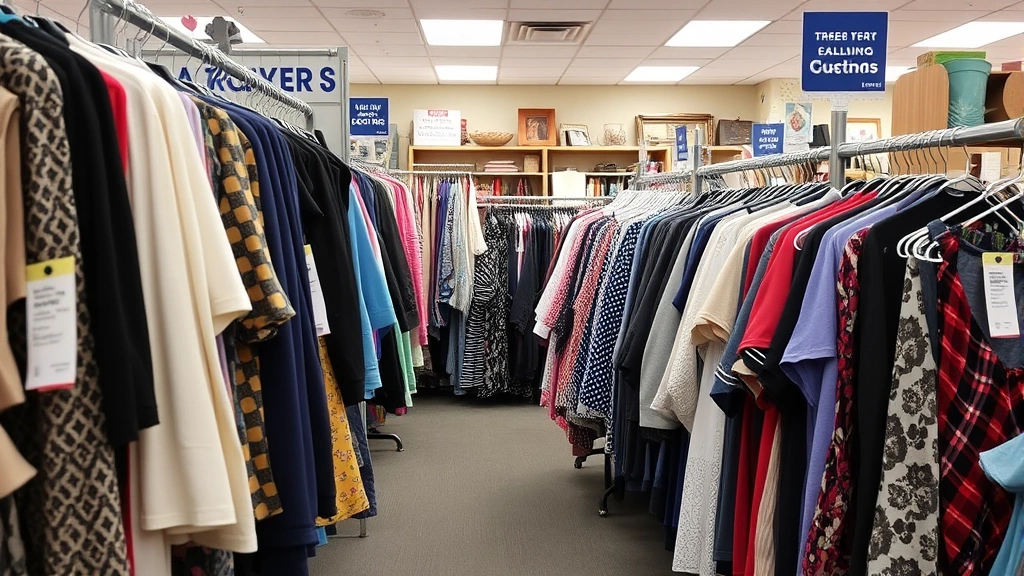
A tax write off for donations to Goodwill is one of the most straightforward ways to reduce your taxable income while cleaning out your closet—but only if you do it correctly. The IRS allows you to deduct the fair market value of clothing, furniture, and household items you donate to qualified charities like Goodwill, yet most people leave money on the table by either not documenting donations or overestimating values. In this guide, we’ll walk you through exactly how to claim these deductions, what the IRS actually accepts, and how to avoid the audit triggers that catch careless donors.
Table of Contents
Goodwill Donations and IRS Rules
Here’s what surprises most people: the IRS doesn’t care that you donated to Goodwill specifically. What matters is whether Goodwill qualifies as a charitable organization. The good news? Goodwill Industries International is a 501(c)(3) nonprofit, which means your donations are fully deductible. But—and this is critical—you can only claim the deduction if you itemize deductions on your tax return rather than taking the standard deduction.
The IRS has been cracking down on inflated charitable deductions for years. According to IRS.gov, noncash charitable contributions are among the most audited deduction categories. This doesn’t mean you shouldn’t claim them; it means you need to be meticulous about valuation and documentation. Think of it this way: the IRS assumes most people overestimate what their used jeans are actually worth.
What Donations Actually Qualify
Not every item sitting in your garage qualifies for a tax deduction. The IRS has specific rules about what counts as a charitable contribution. Clothing and household items must be in “good used condition or better.” That ratty t-shirt with holes? Not deductible. The barely-worn sweater your aunt gave you? Absolutely deductible.
Here’s what typically qualifies:
- Clothing (coats, dresses, pants, shoes, accessories)
- Furniture (chairs, tables, beds, dressers)
- Household items (dishes, kitchenware, linens, towels)
- Books and educational materials
- Electronics (computers, monitors, keyboards—if working)
- Musical instruments
- Sports equipment
What doesn’t qualify:
- Underwear or socks (even unused)
- Items in poor condition (stains, tears, broken zippers)
- Items that don’t function (broken electronics, furniture with missing legs)
- Hazardous materials
A common mistake? People try to deduct items that are damaged or unusable. The IRS definition of “good used condition” is stricter than most people think. If you wouldn’t buy it at a thrift store, don’t claim it as a deduction.
Determining Fair Market Value
This is where most people stumble. Fair market value (FMV) isn’t what you paid for the item originally—it’s what someone would actually pay for it today at a thrift store. That $300 winter coat you bought five years ago? It’s probably worth $20-40 now, not $200.
The IRS provides guidance through Publication 561, which explains how to determine FMV. Here’s the practical approach:
Use the Thrift Store Method: Visit Goodwill, Salvation Army, or similar thrift stores and check actual prices for comparable items. A used button-up shirt typically sells for $3-7. Jeans go for $5-12. A coffee maker might be $8-15. This is your baseline for FMV.
Online Pricing Tools: Websites like Goodwill.org sometimes list typical donation values. ThredUP and Poshmark show what similar used items actually sell for. These are helpful reference points.

The IRS Red Flag: If you’re deducting a bag of 20 shirts at $50 each ($1,000 total), the IRS will likely question it. Be conservative. A more realistic total for 20 used shirts might be $100-150 combined.
Pro tip: Keep a spreadsheet while you’re sorting donations. List each item, its condition, and estimated FMV. This takes 30 minutes but provides solid documentation if questions arise.
Documentation Requirements Matter
You cannot simply claim a deduction without proof. The IRS requires specific documentation for noncash charitable contributions, and the requirements vary based on the total value of your donation.
For donations under $500: You need a receipt from the charity showing the name, date, location, and a description of items donated. Goodwill provides this automatically when you drop off items. Keep it. That’s your primary documentation.
For donations between $500-$5,000: You must file IRS Form 8283 (Section A) with your tax return. You’ll need the charity’s receipt plus a detailed list of each item with estimated FMV. Taking photos of items before donation is smart here.
For donations over $5,000: You need a qualified appraisal and Form 8283 (Section B). This is where most people stop—hiring an appraiser costs $300-500, which only makes sense for high-value items like jewelry, art, or designer clothing collections.
What documentation should you gather?
- Charity receipt with date and location
- Detailed list of items (spreadsheet works fine)
- Photos of items in good condition (optional but helpful)
- Notes on condition (“gently used,” “like new,” “good condition”)
- Your FMV research (thrift store price checks)
Store everything in a folder—digital or physical. If you’re ever audited, you’ll be grateful you have this organized.
Itemized Deductions vs Standard
Here’s the hard truth: if you don’t itemize deductions, your Goodwill donations are worthless from a tax perspective. You can’t claim them at all.
For 2024, the standard deduction is:

- Single filers: $14,600
- Married filing jointly: $29,200
- Head of household: $21,900
Itemized deductions include charitable contributions, mortgage interest, state and local taxes (capped at $10,000), and medical expenses. You only benefit from charitable donations if your total itemized deductions exceed the standard deduction.
Example: You’re married filing jointly with a standard deduction of $29,200. Your mortgage interest is $12,000, state taxes are $8,000, and you donate $3,000 to Goodwill. Total itemized deductions: $23,000. This is less than $29,200, so you’d take the standard deduction instead. Your Goodwill donation provides zero tax benefit.
However, if you also have significant medical expenses or charitable giving from other sources, itemizing might make sense. Many people benefit from understanding tax strategies that help maximize deductions across multiple categories.
Use a tax calculator or work with a CPA to determine whether itemizing makes sense for your situation. Don’t assume donations automatically help.
Noncash Charitable Deductions Explained
The IRS categorizes donations into two types: cash and noncash. Goodwill donations are noncash contributions, which have stricter rules than simply writing a check to charity.
The reasoning? The IRS has seen widespread abuse in this area. People historically inflated values on clothing and household items to claim unrealistic deductions. So the rules are tighter now.
Key rules for noncash charitable deductions:
- Items must be in good used condition or better
- FMV must be reasonable and supportable
- You must have a receipt from the charity
- Form 8283 is required for donations over $500
- Appraisals are required for donations over $5,000 (with limited exceptions)
- The deduction is limited to 50% of your adjusted gross income (AGI) in most cases
That last point matters. If your AGI is $80,000 and you claim $50,000 in charitable deductions, you can only deduct $40,000 in the current year. The remaining $10,000 carries forward to future years. This prevents people from claiming years of donations in a single tax year to create a huge deduction.
Mistakes That Cost You Money
After 15 years as a tax professional, I’ve seen these errors repeatedly:
Mistake #1: Overvaluing Items This is the #1 audit trigger. People think their used clothing is worth retail prices. It’s not. A $60 pair of jeans you wore for two years is worth $5-10 at Goodwill, not $40. Be conservative. The IRS will be.

Mistake #2: Donating Without Getting a Receipt Some people drop off bags at Goodwill and leave without asking for a receipt. No receipt = no deduction, period. Always get documentation.
Mistake #3: Mixing Clothing Donation with High-Value Items If you’re donating mostly $3-5 items but claim a $2,000 total deduction, auditors notice. They’ll dig deeper. If you have legitimate high-value items (jewelry, designer bags, instruments), document them separately with photos and research.
Mistake #4: Forgetting About the AGI Limitation You can’t deduct more than 50% of your AGI in charitable contributions. If you make $60,000 and claim $35,000 in donations, you’re breaking the rules. The excess carries forward, but you might trigger an audit in the process.
Mistake #5: Not Keeping Records Long Enough Keep documentation for at least three years after filing (seven is safer). The IRS has three years to audit most returns, but can go back longer if they suspect fraud.
Annual Donation Limits
The IRS caps how much you can deduct in charitable donations based on your adjusted gross income. For noncash charitable contributions like Goodwill donations, the limit is typically 50% of your AGI.
Here’s how it works:
Example 1: Your AGI is $100,000. You can deduct up to $50,000 in charitable contributions (cash and noncash combined) in the current year. If you donate $60,000 worth of items, the extra $10,000 carries forward to next year.
Example 2: Your AGI is $50,000. You donate $30,000 worth of items to Goodwill and $5,000 in cash to other charities. Total charitable giving: $35,000. Your limit is $25,000 (50% of AGI). You can deduct $25,000 in 2024 and carry forward $10,000 to 2025.
These carryforward deductions don’t expire—you can use them in future years as long as you have sufficient AGI. However, they follow specific ordering rules (cash contributions first, then appreciated capital gain property, then other noncash contributions).
If you’re a high-income earner doing significant charitable giving, work with a CPA to manage these limits strategically. Some people benefit from “bunching” donations in certain years to exceed the standard deduction threshold. Others use donor-advised funds to optimize deductions across multiple years.

Frequently Asked Questions
Can I deduct Goodwill donations if I take the standard deduction?
No. Charitable deductions only benefit you if you itemize deductions on your tax return. If you take the standard deduction (which most people do), your Goodwill donations provide zero tax benefit. You’d need to itemize deductions to claim them.
What if I don’t have a receipt from Goodwill?
Without a receipt, you cannot claim the deduction. The IRS requires documentation from the charity showing the date, location, and description of items donated. Always request a receipt when you drop off items. If you donated without one, you’re out of luck for that donation.
How do I value items I’m not sure about?
Visit a Goodwill or thrift store and check actual prices for comparable items. This is the most defensible method. You can also research similar items on ThredUP, Poshmark, or eBay (look at “sold” listings, not asking prices). Be conservative—when in doubt, go lower.
Can I deduct donations to other thrift stores besides Goodwill?
Yes, as long as the organization is a qualified 501(c)(3) charity. Salvation Army, Habitat for Humanity ReStore, and many local nonprofits qualify. Check the IRS Tax Exempt Organization Search tool to verify. Goodwill is just one option—the rules apply the same way to all qualified charities.
What happens if I overvalue donations and get audited?
The IRS will disallow the excess deduction and you’ll owe back taxes plus interest. If the overvaluation was intentional (not just careless), you could face penalties of 20-75% of the underpaid tax. This is why conservative valuations matter. It’s better to underestimate and leave money on the table than overestimate and face penalties.
Can I deduct donations of used electronics?
Yes, if they’re in working condition. A used laptop that powers on and functions is deductible. A monitor with a cracked screen is not. The item must be usable—if you wouldn’t buy it at a thrift store in its current condition, don’t claim it as a deduction.
Do I need an appraisal for my clothing donations?
Only if the total value exceeds $5,000. For most people donating clothes and household items, you’ll stay under $500 or $5,000, so an appraisal isn’t required. Your receipt from Goodwill plus your detailed list of items with estimated values is sufficient documentation.
Can I deduct donations made throughout the year if I didn’t get receipts?
No. You need a receipt for each donation. If you’ve been dropping items off at Goodwill without requesting receipts, you can’t claim those donations. Going forward, always ask for documentation. Some Goodwill locations provide digital receipts via email if you provide contact information.